

Sep
Table of Contents
Elephant Parade – introduction
Elephant Parade is a social enterprise that organizes worldwide open-air art exhibitions. These feature life-size, hand-painted baby elephant statues to raise awareness and money for the conservation of the Asian elephant. Each elephant statue is a unique creation by artists or celebrities. They are displayed in host cities and auctioned to support elephant welfare organizations like Elephant Family and Friends of the Asian Elephant Hospital. Elephant Parade donates at least 20% of net profits, with a minimum of €50,000 annually, to these organizations.
Mosha, the first elephant with a prosthetic limb
The story of Elephant Parade begins in Chiang Mai, where Dutch father and son Marc and Mike Spits met a young elephant named Mosha. Along the Thai-Myanmar border -Mosha lost part of her leg after stepping on a landmine. At the hospital from the Friends of the Asian Elephant foundation (FAE) they fitted her with a prosthetic limb. Mosha was the first elephant in the world to undergo that treatment. The hospital of is on the road from Chiang Mai to Lampang, about 20km before you reach the city of Lampang. Mosha inspired father and son Spits to do something to help the cause of elephants in Thailand.
The birth of Elephant Parade
The Asian elephant is Thailand’s national animal and once adorned the national flag roughly from 1843 until 1917. Since 1986 however , the International Union for Conservation of Nature (IUCN) had listed the Asian elephant as endangered on its Red List. The population had declined by at least 50 per cent over the last three elephant generations, which is about 60–75 years. The idea grew to blend art, awareness and conservation into a masterplan that ultimately became Elephant Parade in 2006. Chiang Mai became the home of the company and still is.
Worldwide parades
In 2007 the first Elephant Parade took place in the city of Rotterdam in the Netherlands. After that the company organized parades in Antwerp (2008), London (2010), Copenhagen (2011), Singapore (2011), Hong Kong (2014), Bangkok (2015), Mumbai (2017/2018), São Paulo (2017), Rio de Janeiro (2018), and Burbank (2024), to name a few. Each parade features 40–250 uniquely designed elephant statues which are placed in public spaces like streets, parks, and landmarks. They attract millions of visitors and raise millions for the conservation of the Asian Elephant.
Elephant Parade Land
I remember visiting the first office of the company on Chiang Mai Land, a side street of Chang Klan road in central Chiang Mai, in 2008. After that the company moved its office to Elephant Parade House in the Wat Ket neighbourhood. In. 2016 the company moved to a much spacier compound in the outskirts of Chiang Mai: Elephant Parade Land.
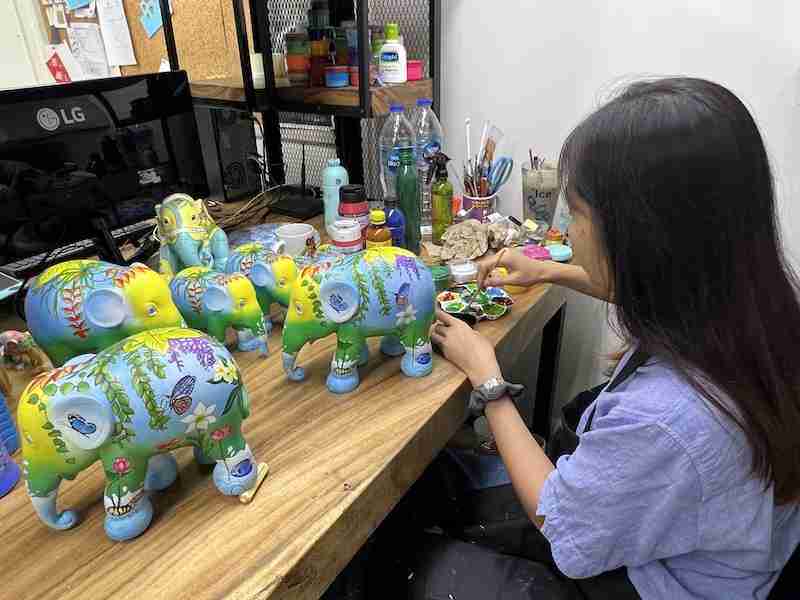
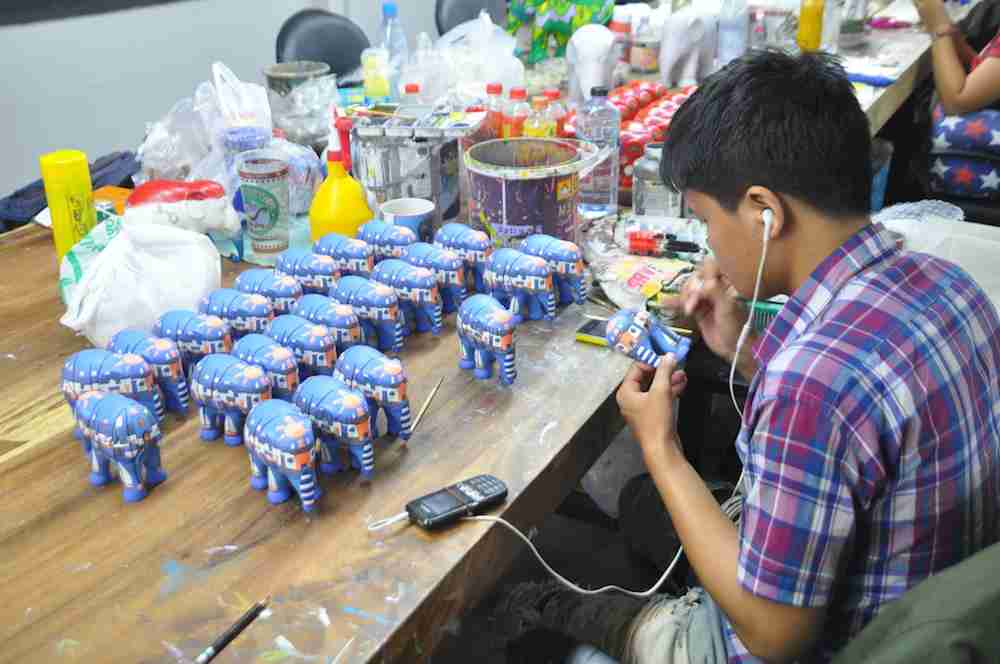
the compound houses the production studio and a museum that tells the story of this fantastic social enterprise. In the gardens you can admire life-size elephant statues and you can also watch a video about the parades. If you want you can paint your own small elephant statue. This activity we include in some of our educational tours for schools and universities.
Facts about Elephant Parade Land
Elephant Parade Land is open from Monday to Friday, from 0830 until 0530 but closed on Saturdays and Sundays. You don’t have to book in advance but if you are with a group it is recommended. Entrance if free but you have to pay for the workshop and souvenirs. There is parking space and there are restaurants nearby.
Share this:
