
The Akha Trail of Chiang Rai
| Price per person in THB | ||||||
|---|---|---|---|---|---|---|
| 2 persons | 3 persons | 4 persons | 5 persons | 6 persons | 7 persons | 8 persons |
| 4,400 | 3,200 | 2,600 | 2,300 | 2,100 | 1,900 | 1,800 |
This is a private trip that starts and ends at your hotel in Chiang Rai. Enjoy a lovely boat ride on the Kok River to the start of our 7,5km Akha Trail through the mountains to the Akha village of Ban Apha where will learn about the culture, life style and traditional dress of these tough mountain people. After this we bring a refreshing visit to the small but lovely Huay Mae Sai Waterfall in a jungle setting. The Akha Trail of Chiang Rai is a wonderful day out in nature, far from the hustle and bustle of the big city.
Driving time today is not longer than about one hour


From: 4,400.00 ฿
The Akha Trail of Chiang Rai
This tour is private. No one else will join you. For the best time to go trekking in Chiang Mai, check out this page.
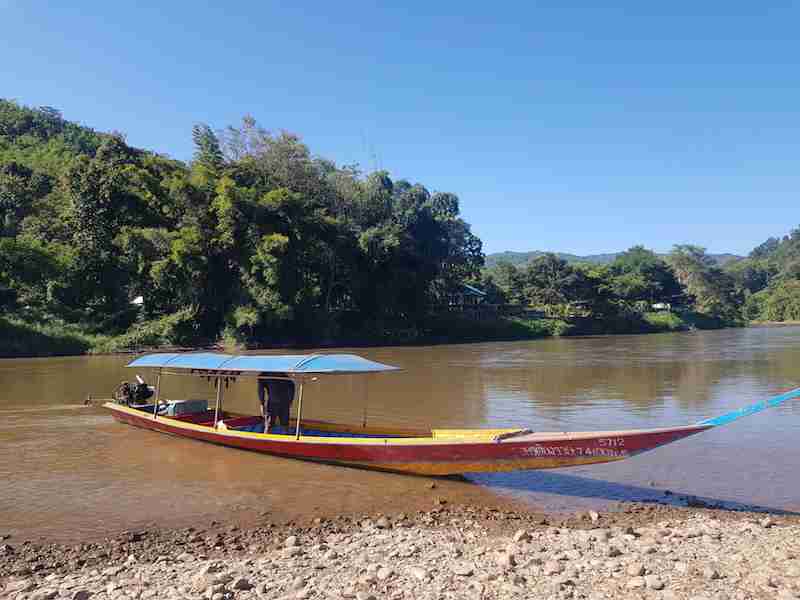
Your guide and driver will meet you at your hotel in Chiang Rai at 08:30 to start your full-day adventure, “The Akha Trail of Chiang Rai.” A short drive brings us to the banks of the Kok River, where our private local boat awaits. The Kok River originates in Myanmar and eventually joins the Mekong River. Before the construction of modern roads, it served as an important transportation route. In earlier days, travelers often journeyed along the river on bamboo rafts. Those times have passed, but the river remains a beautiful and vital waterway.
Our scenic 40-minute boat ride offers a glimpse of impressive limestone landscapes and life along the riverbanks. We disembark near the Karen village of Ruammitr, where our local Akha guide will be waiting for us. He comes from the village of Ban Apha and will lead us on a 7.5 km trail (elevation gain: 423 m) through the forested hills to his home village. The Akha Trail of Chiang Rai usually takes us about 3 to 3,5 hours to complete the hike, including many stops along the way.

The beautiful and educational Akha Trail through the mountains of Chiang Rai
We begin our hike along a dirt road with views of rice fields before ascending gently through a rubber plantation. This is the domain of the Akha people, one of the main ethnic groups inhabiting these mountains. The trail gradually climbs, but the pace is easy, allowing time for stories and insights shared by our Akha guide. As we leave the plantation behind, the path leads into a mixed forest, taking us up and down gentle ridges, far away from roads, villages, and the noise of the modern world.
The Akha are a mountain people who originated in southern China, probably from the Tibetan Plateau, and migrated south into Southeast Asia during the early 20th century. Today, Akha villages can be found in Myanmar, Yunnan (China), Laos, and northern Thailand, particularly in Chiang Rai province. They have their own language, traditions, and spiritual beliefs, distinct from Thai culture.Once we gain some altitude, we’ll be rewarded with magnificent views over the Kok River Valley and the surrounding mountain ranges.


An old fruit, tea and coffee plantation
We’ll find a pleasant spot along the Akha trail of Chiang Rai to enjoy our picnic lunch. Few travelers know about this hidden path, which makes it even more special. After lunch, we begin our descent toward Ban Apha, passing through a diverse plantation filled with tropical fruit trees and crops. Depending on the season, you may see banana, rambutan, papaya, mangosteen, and longan trees, as well as coffee, tea, cacao, and even pineapple plants carpeting the ground. It’s a delightful walk, and we’ll sample some fresh fruit once we reach the village.
Before entering Ban Apha, we’ll stop at the last remaining traditional Akha house on stilts. It is a reminder of how all Akha houses looked some 50 years ago. We’ll then visit the home of our friend Armue and his family, who will introduce us to the stunning traditional attire of the Akha Loimi people, including the intricately decorated headgear worn by Akha women.


The Huay Mae Sai Waterfall
After learning about Akha culture and traditional dress, we drive a short distance to the Huay Mae Sai Waterfall, a small but charming cascade nestled in lush jungle. Few visitors make it to this peaceful spot, making it ideal for a moment of quiet reflection. A good trail leads to two higher levels of the waterfall, where you can cool off in the refreshing pools if you wish. Relax and enjoy the serene natural setting before we drive back to Chiang Rai, where your guide will drop you off at your hotel.
We hope you enjoyed “The Akha Trail of Chiang Rai” and thank you for joining us—on behalf of the Akha people of Ban Apha as well.


Highlights
Lovely boat trip on the Kok River
Trekking through the highlands of Chiang Rai
Learning about the different crops, fruit trees and plants
Meeting the Akha people
Bathing in the Huay Mae Sai Waterfall
Fantastic views of the Chiang Rai mountains
Learning about Akha culture and traditional dress
Inclusions
Private tour
Transportation by local truck
English-speaking guide
Picnic lunch in the forest
Drinking water during lunch
Visit of the Akha village of Ban Apha
Limited medical insurance
What to bring
What to bring
Comfortable shoes with good grip (especially in the rainy season from May until November)
Swimwear to bathe in the Huay Mae Sai Waterfall
A hat or cap
Light raincoat (even in the dry season it rains occasionally)
Sunscreen
Sunglasses
Personal medication (if any)
Time Line
0830 – Departure from the hotel
0900 – Start of the boat ride
0945 – Disembark from the boat
1000 – Start trekking, enjoy lunch along the way
1300 – Arrival at the Akha village of Ban Apha
1430 – Drive to the Huay Mae Sai Waterfall
1445 – 1600 Relax and swim at the waterfall
1600 – Return to Chiang Rai
1645 – Arrival at the hotel
Related products

Green Trails Expeditions

Green Trails Expeditions