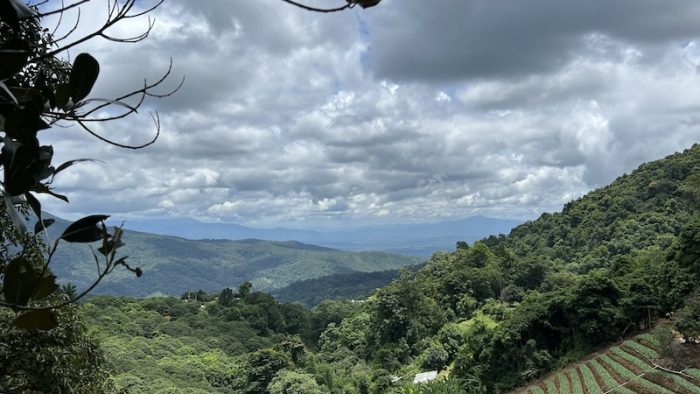
The Ancient Caravan Trail to Chiang Rai – four days
Follow the old scenic Caravan Trail from Chiang Mai to Chiang Rai – Private Tour
This is a private tour. If you are interested in this tour, we can customize it according to your wishes. The total distance of this tour is 334.4 km. We travel the route that was used by the Haw Chinese caravans from Yunnan more than a century ago. This was “opium country“. Opium was cultivated at many locations in North Thailand. The KMT (Kuomintang) forces that occupied Doi Mae Salong were involved in the opium trade, and border areas were sometimes the battleground of armies of rival drug lords. Less than fifty years ago, this region was a lawless area, controlled by drug lords.
We travel via the remote Doi Angkhang mountain range to Thaton and onwards to the Yunnanese Chinese community of Santikhiri on Doi Mae Salong. There is a lot of recent, unwritten history in these mountains. From there we drive to Ban Apha, an Akha Lomi village where we will meet the people and enjoy lunch with them. Before we drop you off at the hotel in Chiang Rai we will visit the Red and Blue Temples.
* Please note that the price of 3, 5 and 7 persons is based on a twin/double room and an extra bed. If you want two rooms there will be a surcharge.
** Per April 7 we charge 1,000THB per person extra for the whole 4-day tours to offset the increase of gasoline prices.
| Price per person in THB | ||||||
|---|---|---|---|---|---|---|
| 2 pax | 3 pax | 4 pax | 5 pax | 6 pax | 7 pax | 8 pax |
| 20,900 | 15,900 | 13,400 | 11,700 | 10,700 | 10,000 | 9,500 |

The Ancient Caravan Trail to Chiang Rai
Day 1: Chiang Mai – Chiang Dao
Total distance today appr. 110 km, driving time about 2.5 hours
The Dara-ang people of Chiang Dao
This is a private tour. Your guide and driver will meet you at the hotel for your Ancient Caravan Trail to Chiang Rai trip. We will drive to Chiang Dao, north of Chiang Mai. Our first stop is the fascinating market of Mae Malai. It is one of the oldest local markets in Chiang Mai province. After that, we will continue to the Chiang Dao district to visit a village where Lisu and Akha minorities live next to each other. We will chat with locals and take a short walk through the village. Then we continue to Pang Daeng Nai, a village of the Dara-Ang people aka as Palong people in Thailand.
Here we will start our short trek through the forest to Mae Chon, another Palong village, to have lunch. Most of the Dara-ang people entered Thailand via the border crossing at the village Nor Lae on the mountain Doi Angkhang where you will travel to tomorrow.Your guide will teach you to cook in a wok on a wood fire. It is a lot of fun. Let’s hope something delicious will be the result.


The Chiang Dao Cave Temple
After lunch, we will drive back to the town of Chiang Dao. Doi Luang Chiang Dao is the third-highest mountain in Thailand and looms large over the town. The Chiang Dao Cave Temple is one of the most sacred Buddhist sites in North Thailand. These limestone caves are lovely, so we will take our time to visit them. The caves house centuries old Buddha images and statues. With a local guide, we will explore one of the more remote parts of the cave system. Don’t worry: this cave is very safe. Not far from the Chiang Dao Cave Temple is Wat Tham Pha Plong, another exceptional cave temple that serves as a Buddhist retreat. After this, we will check into the Marisa Resort, lovely accommodation in a quiet forest. Please note: on this day, we can also arrange an overnight in the village if you wish.


Day 2: Chiang Dao – Thaton
Total distance today appr. 260 km, driving time about 6 hours
The fascinating road to Doi Angkhang
Our destination today is Doi Angkhang, a remote mountain resort close to the Thailand-Myanmar border. This is an off the beaten track route that bring you to remote parts of North Thailand. Our first stop will be at the beautiful Sri Sangwan Waterfalls in the Pa Daeng National Park. After our dip in the “other Sticky Waterfalls“, we’ll continue to the sprawling Yunnan Chinese settlement of Arunothai, only about 3 km from the Thai-Myanmar border. This former refugee camp is now a fast-growing town in a stunning setting.
We then follow a narrow, winding road, skirting the border through dramatic landscapes and magnificent views. During our drive, we pass through several more Chinese villages. Many of the inhabitants of these villages are descendants of soldiers of the Kuomintang forces who entered Thailand during the 1950s and 60s. We stop briefly at the former headquarters of General Li Wen Huan in Tham Ngob. General Li was the commander of the 3rd division of the Kuomintang (KMT) army. During the early 1970s, hundreds of soldiers were based here.


The Royal Project and tribal villages
After arrival at Doi Angkhang, we will first have lunch. After lunch, we will visit the Royal Project. His Majesty King Bhumibol Adulyadej and members of Thailand’s royal family have set up numerous village-based community development projects nationwide, now open for small-scale tourism. They provide unique insights into King’s concept of a sufficiency economy and are alternative economic development models.
On Doi Angkhang, there are two fascinating and beautifully located ethnic minority villages. Nor Lae is a village of the Palong people, right on the Thailand-Myanmar border. This is where most of the Dara-ang people, who live in the Chiang Dao district, crossed the border in the 1980s and asked the King Bhumibol of Thailand, Rama IX, permission to stay in Thailand. The King granted this permission. Not far from this village is Kob Dong, a Black Lahu village. We will briefly visit both villages, which are beautifully located.


Finally, it is time to descend Doi Angkhang to the riverine town of Thaton, where we will spend the night. Overnight will be at the Maekok River Village Resort on the Kok River.
Day 3: Thaton – Doi Mae Salong
Total distance today appr. 30 km, driving time about 1 hour
Boat ride on the Kok River
Good morning! After breakfast, we continue our Ancient Caravan Trail to Chiang Rai. First, we will drive up to Wat Thaton, where we have a marvelous view of Thaton and the surrounding countryside. Next, we board a local boat on the Kok River for a refreshing boat ride. After about 45 min, we will disembark at the Lahu village of Pha Tai and continue by car to Santikhiri, a community on Doi Mae Salong. During our drive, we will visit one of the many Akha villages. Most Akha villages are in Chiang Rai province, and we will spend some time in this village.
During our walk, your guide will introduce you to local people and explain the culture and traditions of the Akha people. After that, we will continue to Santikhiri on Doi Mae Salong. In 1961 remnants of Kuomintang troops settled on Doi Mae Salong and became involved in the opium trade. Because they helped the Thai military fight the communist insurgence, the Thai government allowed them to stay on the mountain. The scenery of Doi Mae Salong is stunning, and the place has a great atmosphere.


Sunset visit of Wat Santikhiri
Nowadays, most inhabitants of Santikhiri are still ethnic Chinese, giving this pretty mountain village a distinctly Chinese feel. We visit one of the tea shops and tea plantations before having lunch in a local restaurant. After lunch, we will visit The Martyrs’ Memorial Hall, a museum that tells the story of the history of the Kuomintang forces after their expulsion from China by the Communists in 1949. Finally, we will go up to Wat Santikhiri, a temple on a mountaintop overlooking the town and its surroundings, for sunset. There is a staircase to the top, which we recommend you take because it is an excellent workout.
We spend the night at Ban Hom Muen Li, our favorite hotel. We chose this hotel because the views from your balcony are amazing.


Day 4: Doi Mae Salong – Baan Apha – Chiang Rai
Total distance today appr. 90 km, driving time about 2 hours
Cooking with the Akha people
After breakfast, we descend the highlands to the plains of Chiang Rai. Our destination today is the Akha village Baan Apha. We will be the guests of Armuh and his family. First, we will drive to the Huay Mae Sai Waterfall, relax, and meet our Akha guide. We relax at the falls before we hike to Baan Apha, a traditional Akha village. Although most people in the village only wear traditional dresses during special occasions, you will see some of the typical Akha dresses. At Armuh’s house, you will join another cooking course on a wood fire. During our stay, we will also try to teach you some words in the Akha language. After we have finished cooking, we will enjoy our self-made lunch.


The Red and Blue Temples of Chiang Rai
After lunch, we will spend some time with the family before we leave the village. We hope that you can say “thank you” in the Akha language: “Gulung guma deh.” Next, we briefly stop at a nearby Yao (Mien) village, where we will admire their lovely textiles and meet some of the people. It is about half an hour drive to Wat Huay Pla Kang aka the “Red Temple” or the Chinese Temple. A enormous statue of the Chinese Goddess of Mercy Kuan Im dominates this impressive complex. It is the temple of philanthropy. This temple raises money to support the poor people of Chiang Rai province.
We take the elevator in the statue to a top floor where we enjoy a wonderful view of the area. Before we drop you off at your hotel we will stop at the magnificent Wat Rong Suea Ten aka the “Blue Temple“. We will spend some time here admiring the craftsmanship of the temple that has become very popular. Don’t forget to taste the delicious coconut ice cream that is for sale here. After this last visit we will drop you off at your hotel. We hope you enjoyed your Ancient Caravan Trail to Chiang Rai trip.


If you are interested in this tour, please email info@green-trails.com to request a customized itinerary.
Highlights
Epic Highlights of the Ancient Caravan Trail to Chiang Rai:
Scenic Off-the-Beaten-Track Route: Traverse a stunning, less-traveled routhe through Northern Thailand with breathtaking views and untouched landscapes
In-Depth Village Visits with Home Cooking: Experience the heart of local life in Palong and Akha villages, where you’ll connect with the community and learn to cook traditional dishes over a wood fire
Chiang Dao Caves: Explore the mystical Chiang Dao caves, where centuries-old Buddhist statues and serene surroundings create a deeply spiritual atmosphere.
Cave Temple Wat Tham Pha Plong: Discover the tranquility of Wat Tham Pha Plong, a hidden gem and Buddhist retreat nestled within limestone caves, offering a peaceful respite from the world.
Royal Project on Doi Angkhang: Visit the Royal Project at Doi Angkhang, where sustainable agriculture and royal-led community development provide a fascinating insight into Thailand’s royal heritage.
the Sri Sangwan Waterfall: Refresh in the enchanting Sri Sangwan Waterfall in Pa Daeng National Park, where you can climb the unique “Sticky Waterfalls” without slipping!
Palong and Black Lahu Villages on Doi Angkhang: Visit the stunning Palong and Black Lahu villages perched on the slopes of Doi Angkhang, where the peaceful mountain life blends seamlessly with history.
Two Boat Trips on the Kok River: Drift down the Kok River twice, soaking in the beauty of Northern Thailand’s riverside villages and lush landscapes.
Wat Thaton: Reach new heights with a visit to Wat Thaton, offering panoramic views of Thaton and the surrounding valleys—a perfect spot for reflection and appreciation of nature.
Chinese KMT Villages: Delve into the history of Chinese Kuomintang villages, where remnants of the past still live on, providing a unique window into this fascinating chapter of Thai history.
Chinese “Mountain Enclave” Doi Mae Salong: Experience the Chinese “mountain enclave” of Doi Mae Salong, where tea plantations, charming villages, and rich heritage make this a must-see destination.
Tea Plantations: Wander through the scenic tea plantations of Doi Mae Salong, tasting some of the finest local brews and learning about the history of tea production in the area.
Museum of the Martyrs: Gain deeper insight into the history of the Kuomintang forces at the Museum of the Martyrs, a moving tribute to the region’s turbulent past.
Wat Santikhiri: Climb the temple steps to Wat Santikhiri, where a stunning sunset over the mountains awaits, offering panoramic views
Inclusions
What is included?
English speaking guide
Transportation in an AC minivan
Accommodation as mentioned
Breakfast and lunch
Drinking water during meals
Entrance fees
Limited Medical insurance
What is not included
All drinks except drinking water during meals
Personal expenses
Tips
Related products