
Secrets of Doi Suthep: Temples, Trails, and Hmong Villages
| Price per person in THB | ||||||
|---|---|---|---|---|---|---|
| 2 persons | 3 persons | 4 persons | 5 persons | 6 persons | 7 persons | 8 persons |
| 9,500 | 7,000 | 5,900 | 5,200 | 4,600 | 4,300 | 4,000 |
This is a private trip. For the people of Chiang Mai Doi Suthep (Suthep Mountain) is a sacred mountain. There are many myths and legends about the mountain and the mountain is home to two of the most revered Buddhist temples: Wat Phra That Doi Suthep and Wat Pha Lat. On the first day of this trip we will visit these temples, take a nice walk through the jungle to admire a centuries-old fig tree and end the day at the Hmong village of Doi Pui, where we wil spend the night. The next day we will follow the historical opium trail that King Bhumibol Adulyadej walked in the 1960s and inspired him to start his famous Royal Project. Hmong guides will accompany us and explain about the history. It is a fantastic hike of about 12km that ends in the Hmong community of two adjoining villages: Ban Mae Sa Mai and Ban Mae Sa Noi.
Driving time:
First day: about one hour
Second day: about one hour


From: 9,500.00 ฿
Secrets of Doi Suthep: Temples, Trails, and Hmong Villages
Day 1: Chiang Mai – Ban Doi Pui
The Temple of the Sloping Cliff
This is a private tour. Please read this page for the best time for trekking. Your guide and driver will meet you at your hotel at 0800 for your trip “Secrets of Doi Suthep: Temples, Trails, and Hmong Villages“. After a short introduction we will drive up to Doi Suthep, the iconic mountain overlooking Chiang Mai. Over the next two days, you will explore the magnificent Doi Suthep–Pui National Park. First, we stop at the statue of the monk Kruba Srivichai at the start of the road up to Wat Phra That Doi Suthep. Followers of Kruba Srivichai, popularly known as the “Monk Engineer” constructed this road, which opened on 30 April 1935.
Thai Buddhists revere him deeply, and you’ll have the chance to observe many people paying respects. Then, we continue to Wat Pha Lat, the “Temple of the Sloping Cliff.” Also known as “Chiang Mai’s Secret Jungle Temple”, this site lies tucked in the forest and, after decades of neglect, has undergone a remarkable revival in the past decade. Your guide will share its fascinating history.


Wat Phra That Doi Suthep
After exploring Wat Pha Lat, we drive further up the mountain to a viewpoint offering the first panoramic view of Chiang Mai. From there we proceed to Wat Phra That Doi Suthep, the best-known temple in Chiang Mai. As you will find, many visitors—especially Thai pilgrims—come here.
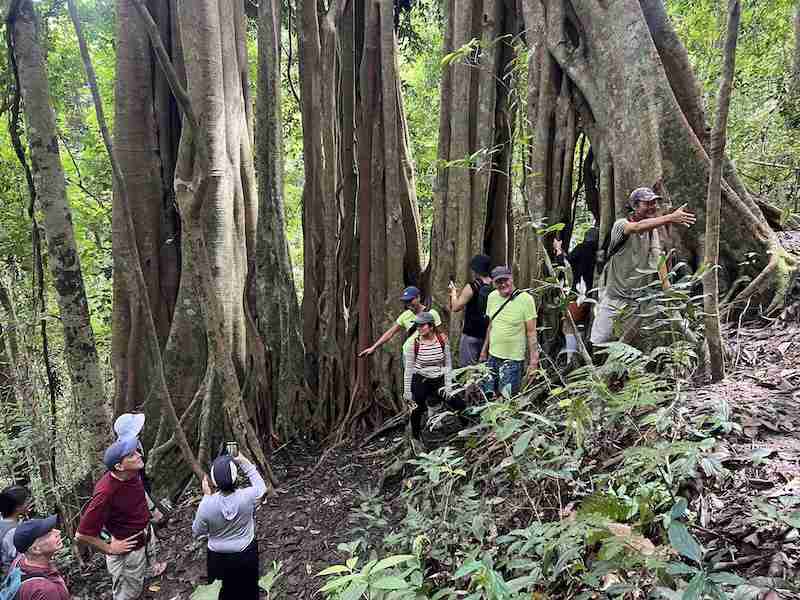
We will ascend the 300-step Naga staircase to reach the temple, which dates back to the reign of King Kuena. According to legend, the king sent an elephant carrying a Buddha relic up the mountain; when it died at a specific spot, the temple was built there. While at the temple, you’ll learn more about Buddhism and enjoy up the spectacular views of Chiang Mai below. Afterwards, we descend the staircase and take a short forest walk to a giant fig tree, likely more than a century old.


The Flower Gardens of Bhubing Palace
After this, we drive up to the gardens of the Bhubing Rajanives Palace, constructed this palace in 1961 for the Royal Family. It is of interest because the late King Bhumibol Adulyadej (Rama IX) started visiting the Hmong villages and their opium fields on top of the mountain, during a stay at this palace. It was the beginning of the groundbreaking Royal Project, that transformed the lives of the mountain people living on the mountain. We will visit the gardens and after that enjoy a delicious Thai lunch in one of the restaurants. Only the gardens are open for the public. Nowadays members of the Royal Family usually stay in the Shangri La Hotel in downtown Chiang Mai when they visit Chiang Mai.


The Hmong village of Doi Pui
Finally, we arrive at the Hmong village of Doi Pui, our home for the night. Because of its accessibility, the village has many visitors both local and foreign, and some may perceive it as a “tourist trap.” However, we will go deeper than the first row of souvenir shops: after checking into our home stay, we will explore the village and meet Hmong residents. The Hmong people migrated from China, settled in northern Thailand, and have a rich yet turbulent history; you will learn about their story at the small but informative village museum. It is time to enjoy the sunset from our homestay and then take a shower. We will end the day with dinner on the terrace of our home stay, surrounded by mountain air and views.

Day 2: Ban Doi Pui – Chiang Mai
Trekking to Doi Pha Klong
After breakfast, we meet our Hmong trekking guide who will lead us through the forest to Doi Pha Klong, about halfway to Ban Mae Sa Noi, our destination. Our trail, which have named “The Opium Trail”, starts by passing a waterfall and leaving the village behind. This is the trail King Bhumibol Adulyadej (Rama IX) followed in 1969 to Hmong villages and their opium fields on the mountain. This visit inspired him to initiate the Royal Project.
The hike covers about 12 km from Ban Doi Pui to Doi Pha Klong and then onward to Ban Mae Sa Mai / Ban Mae Sa Noi, with an elevation gain of approximately 436 m. Usually it takes 4.5 to 5 hours, including stops and a picnic lunch along the way. Enjoy the lush forest and the changing terrain: the trail begins gently and then climbs steeply toward Doi Pha Klong. Once at the top, we pause for lunch and enjoy the sweeping views on both sides of the mountain (weather permitting).


Change of Guides
At Doi Pha Klong we will say farewell to our guide from Ban Doi Pui and be joined by a Hmong guide from Ban Mae Sa Noi. From here the trail opens up with views of the lowlands of Mae Rim and clearings that once were opium fields. We re-enter the forest and may see wild pig tracks. Our guide will explain how villagers protect the forest, and how our trail serves as a fire-break in the dry season (as seasonal fires are a serious problem on Doi Suthep). After a long descent on a narrow forest path we reach the Hmong community of Ban Mae Sa Mai; before entering the village we will pause to admire a small waterfall.


The textile center of Ban Mae Sa Noi
We then pass through Ban Mae Sa Mai and visit the community textile center of neighboring Ban Mae Sa Noi. Here we will relax and, if we’re lucky, witness local people practizing traditional Hmong batik. We’ll stroll through the village, enjoy views over the Mae Sa Valley and the village fields. On our way back to Chiang Mai, we make a brief stop at the tree-nursery of the Forest Restoration Research Unit (FORRU) of Chiang Mai University. Villagers and researchers have collaborated already for years to restore deforested land. Finally, we drive back to Chiang Mai and conclude this memorable journey “Secrets of Doi Suthep: Temples, Trails, and Hmong Villages” through the natural and cultural heritage of Doi Suthep–Pui National Park.


Highlights
Highlights
Wat Pha Lat – the temple of the sloping cliff
Wat Phra That Doi Suthep
Short jungle walk to the centuries old giant fig tree
Visit the rose garden of the Bhubing Palace
Explore the Hmong village of Doi Pui (Ban Doi Pui)
Visit the small museum of Ban Doi Pui
Dinner with sunset view
Hiking the Opium Trail, a historic trail that King Bhumibol Adulyadej walked in the 1960s
Doi Suthep-Pui National Park
Doi Pha Klong historic site
Visit the Hmong villages of Ban Mae Sa Mai and Ban Mae Sa Noi
Inclusions
Included
Transportation by minivan
English speaking guide
Local Hmong guides
One breakfast, two lunches, one dinner
Drinking water during meals
Overnight in a room in a homestay in the Hmong village of Doi Pui
Limited medical insurance
Not included
Drinking water except during meals
Personal expenses
Tips
What to bring
What to bring
In general things for one overnight
Short sleeve shirts for the daytime (bring a spare one, just in case)
Long sleeves for the evening (especially in the “winter” from November until February it can be a bit cold)
Shoes with good grip (especially in the rainy season from May until September)
A hat or cap
Raincoat (even in the dry season it occasionally rains)
Sunscreen
Sunglasses
Your toiletries
Personal medication
Time Line
Day 1
0800 Departure from the hotel
0845 Wat Pha Lat, the temple of the sloping cliff
0945 Continue to Wat Phra That Doi Suthep
1000 Viewpoint
1030 Wat Phra That Doi Suthep
1230 Short hike to the centuries old fig tree
1330 Lunch in a restaurant
1430 Continue to the Bhubing Palace
1500 Visit the Rose Garden
1545 Arrival in the Hmong village of Doi Pui. Check into the home stay of our host Leng
1630 Village walk
1730 Relaxation
1830 Dinner
Day 2
0800 Breakfast
0900 Village walk. Visit the old Hmong house and learn about coffee roasting.
1000 Start hiking the Opium Trail
1200 Picnic lunch on Doi Pha Klong
1400 Arrival in Ban Mae Sa Mai/Mae Sa Noi
1500 Departure back to Chiang Mai
1600/1630 – Arrival back on Chiang Mai
The Home Stay
The home stay of Leng in Ban Doi Pui
This home stay has four rooms only. The rooms are relatively comfortable and clean. They have an attached bathroom with hot and cold water and a shower. There is electricity and WiFi. The beds are comfortable.


Related products


Educational Tours


Green Trails Expeditions