Lisu hill tribe - History and Culture

Frans Betgem
Table of Contents
The Lisu people in North Thailand
Origins of the Lisu hill tribe people
The Lisu hill tribe is a Tibeto-Burman highland tribe, originally from southwest China. The exact origin of the Lisu is unknown. All the Lisu people currently living in Thailand came from Myanmar (Burma).

Where do the Lisu people live?
The Lisu people likely migrated along the Salween River Valley from Tibet through China to Burma, driven in part by Chinese pressure. Factors like population growth and soil depletion may have also influenced their movement. They likely entered Thailand no earlier than 200 years ago, with the majority arriving during the 19th century.
Today, Lisu communities are found in Thailand, China, India, and Myanmar. Originally, they moved into northern Thailand from Burma and now reside in provinces such as Chiang Mai, Mae Hong Son, Sukhothai, Tak, Kamphaeng Phet, Phayao, Lampang, and Chiang Rai. However, most Lisu people still live in China, near the headwaters of the Mekong and Salween Rivers, where their ancestral homeland lies.

Lisu hill tribe language
The Lisu hill tribe speaks a language that belongs to the Lolo branch of the Tibeto-Burman language family. There are two scripts in use and the Chinese Department of Minorities publishes literature in both. The oldest and most widely used one is the Fraser script. Sara Ba Thaw, a Karen preacher from Myanmar, invented this script in 1915.
A British Protestant Christian missionary James Fraser improved the script, which was then named after him. The Chinese government invented the second script, that is based on pinyin.
Lisu don’t say hello or goodbye. Here are some useful words and sentences.
Yes
No
Thank you
How much
Good
Very good
Rice
Village
House
Guest room
Food (rice)
Water
Tea
Boy
Girl
What is your name?
Sue
Nusus (nu as in gnu)
A kur bu mo
A mia
How
Aker How
Or
Jazzer
Hee
Etago
Tza
Igya
Chayeh
Zuga
Yumuleh
Nouz emir a lay bay
One
Two
Three
Four
Five
Six
Seven
Eight
Nine
Ten
Twenty
One Hundred
Ti Ngi
Su
Su
Lay
Knee ha
Cho
Shair
Heigh
Gu
Tssur
Nyissur
Tehaya

Lisu hill tribe Religion, Culture, and lifestyle
The religion of the Lisu hill tribe is a mixture of ancestor worship and spirit propitiation. They believe all animate things have an associated spirit, as do some inanimate objects. Vital spirits are those of ancestors, water, mountains, and villages. They are not preoccupied with the afterlife and see the spirit world as something for the present, to be dealt with daily, and believe spirits have emotions and failings the same as humans so that they can be so dealt with.
Occupying villages above 1,000m, they keep livestock and cultivate corn and vegetables. Unlike other tribes, they don’t usually live in stilted houses. Each Lisu house has an ancestral altar. There is a “village guardian spirit shrine in each village,” located above the village, in a roofed pavilion that women aren’t allowed to enter.
The Lisu hill tribe grows rice and vegetables for subsistence. At the same time, these villages are relatively close to the market so that the Lisu can trade. Most Lisu live close to water because they believe water has extraordinary power. In the past, the Lisu people cultivated opium as a cash crop.

Lisu hill tribe traditional dress
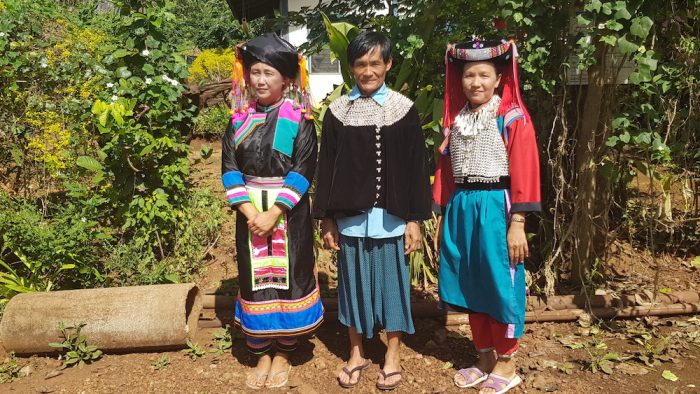
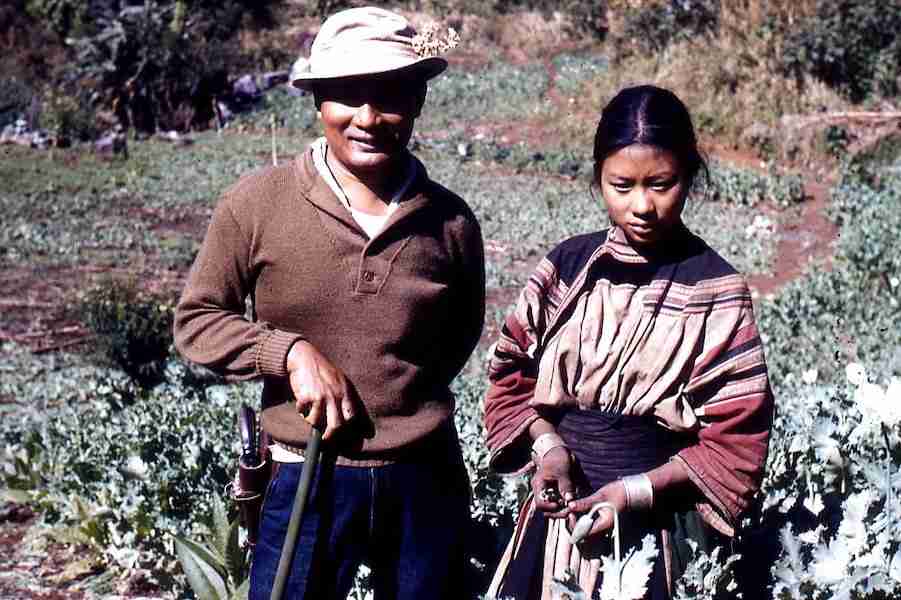
Lisu traditional dress is very colorful, especially the clothing of the women. The Lisu hill tribe women are distinguished by their brightly colored tunics, worn over long pants; some of the older generations continue to wear tasseled turbans on their heads.
The Lisu man’s dress is quite sober. It consists of a black jacket, blue or green pants, and black leggings. Lisu women’s dress is a blue or green tunic, split up at the sides to the waist. It goes down to the knee in front and hangs to mid-calf at the back. It crosses over the chest and fastens under the right arm. The piece across the chest is often a different color from the rest of the dress.
Women wear knee-length black Chinese-style pants and red leggings trimmed with blue cloth, embroidered with other colors. Young girls and women wear black turban during festivals. On New Year, they wear lots of silver jewelry. In Chiang Mai, the small Lisu Cultural Heritage Center exhibits traditional Lisu dress. It is worth visiting.
We successfully organized several textile tours for Haute Culture Tours to a Lisu village. If you are interested in such a tour, please contact us. We also offer a photography tour that features the traditional dress of the Lisu people.
Dutch anthropologist Otome Hutheesing
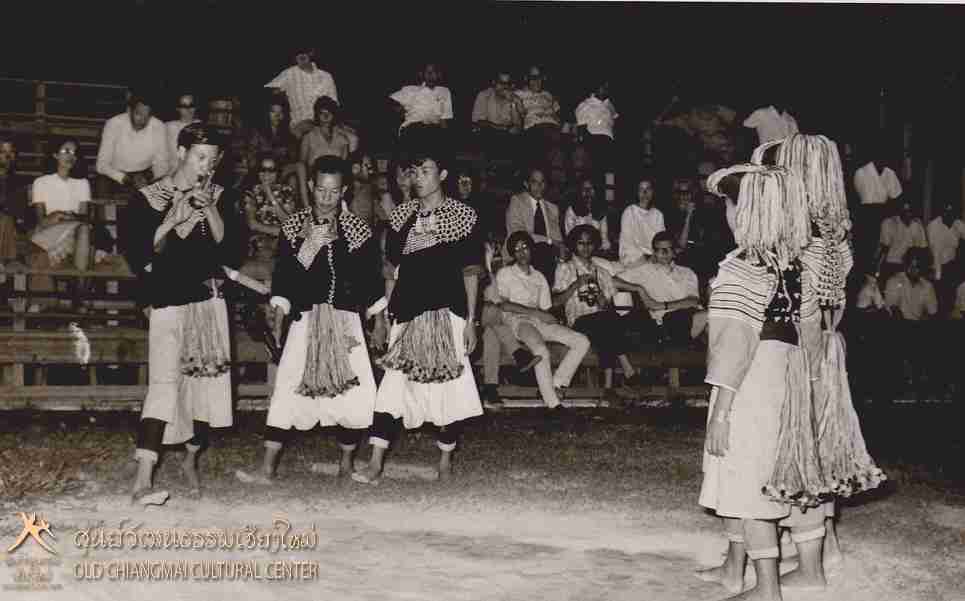
Otome Klein Hutheesing was an anthropologist from the Netherlands. Otome was born in 1930 in Sumatra, which was the Dutch East Indies at the time. She studied sociology at Leiden University in the Netherlands, where she also received her doctorate.
She taught there for several years. After that, she took a job in India with the United Nations Economic, Social and Cultural Organisation. After a failed marriage, she moved first to Malaysia and then to Thailand.
Another Dutch anthropologist, Leo Alting von Geusau, introduced her to the Lisu people. For six years, she lived in the Lisu village Doi Lan, south of Chiang Rai, where she researched, which resulted in a book: “Emerging Sexual Inequality Among the Lisu of Northern Thailand: The Waning of Dog and Elephant Repute.”
She lived in Chiang Mai with her adopted daughter Mimi, where I met both of them. Otome Klein Hutheesing passed away on April 9, 2023. During her stay in the Lisu village of Doi Lan in Chiang Rai province, she took many photographs. She allowed us the publishing of some of them. You can find many of her pictures here.

John Spies, the founder of Cave Lodge
Australian John Spies has lived in North Thailand since 1978. He arrived as a backpacker and was very active in the early days of hill tribe trekking. In 1984 he and his wife founded Cave Lodge in Pang Ma Pha district in Mae Hong Son province. During the early 1980s John took fantastic pictures of a world that is not here anymore. He generously allowed us to post some of his remarkable photos.
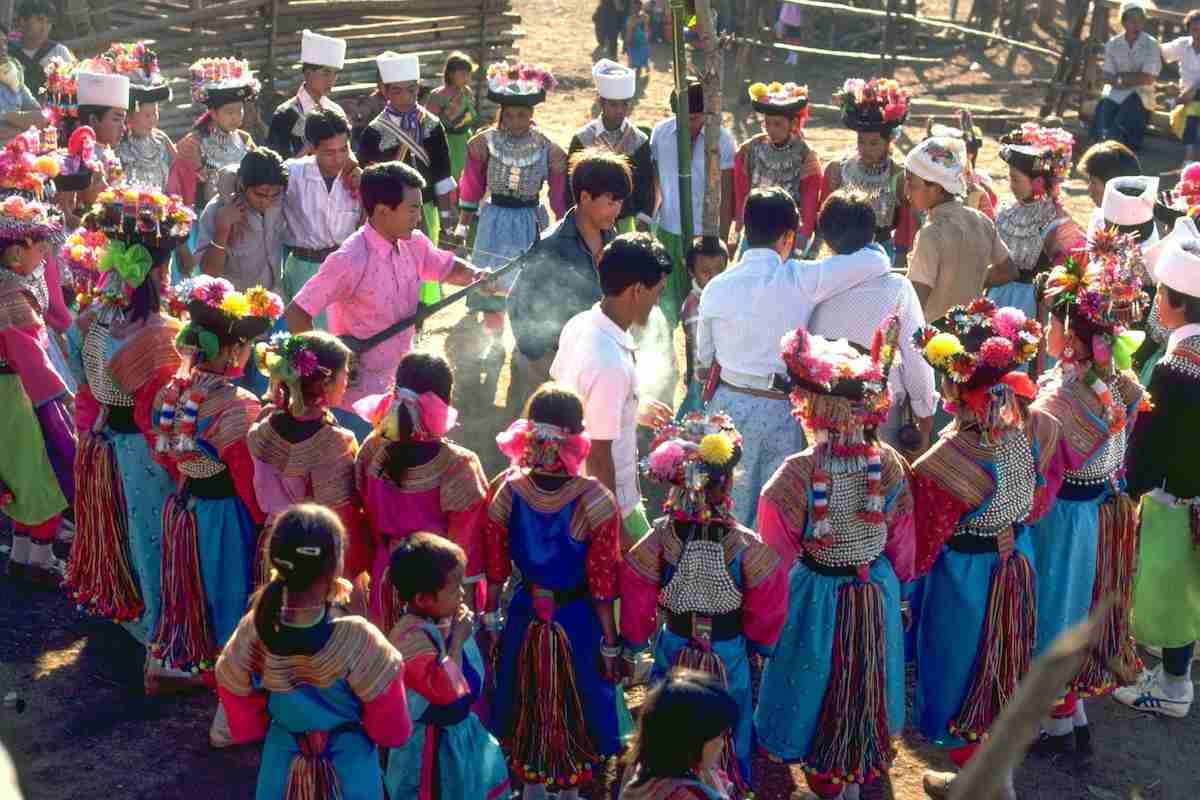
Below picture he took during the Lisu New Year, the early 1980s in Ban Guet Sam Sip, Mae Hong Son. It shows the start of a traditional dance around the tree in front of each house with an ancestor spirit altar. The sky spirits are fed offerings of rice cakes and pork and the dancing continues for several days and nights, moving from house to house for the first few nights. This remote village was a 5-hour walk uphill from the 1095 road, which was still unpaved.
Important Lisu festivals
The main Lisu Festival is the New Year festival on the same date as the Chinese New Year and is celebrated with music, feasting, and drinking. People wear large amounts of silver jewelry and wear their best clothes at these times as a means of displaying their success in the previous agricultural year. More about the Lisu New Year here.
John Spies took below pictures during Lisu New Year in Mae Hong Son Province.

Interesting links and other sources
For more information about sources on the Hmong people and other ethnic minorities in North Thailand, please go to this page.
Meet the Lisu people on Green Trails tours
On these Green Trails tours you can meet the Lisu people: